
Cheng Ye, Gaia Workspace CEO
Background:
Last week, I scheduled a high‑level demo with the facilities team of a large organization in public sector. A few minutes into the discussion, I realized I had missed the most important point. I was spending too much time on operational details—such as access control, booking policies, approval process and checklist, etc., rather than addressing the fundamental challenge they were facing.
For large organizations, the real priority is not improving individual booking features but transforming office management from a headcount‑based model to a behavior‑based one, powered by genuine office usage insights. Without establishing this shift in thinking as the starting point, even the most sophisticated facility applications and workflows fail to deliver meaningful value. Detailed tools only work when we are built on a clear understanding of how people actually use the office.
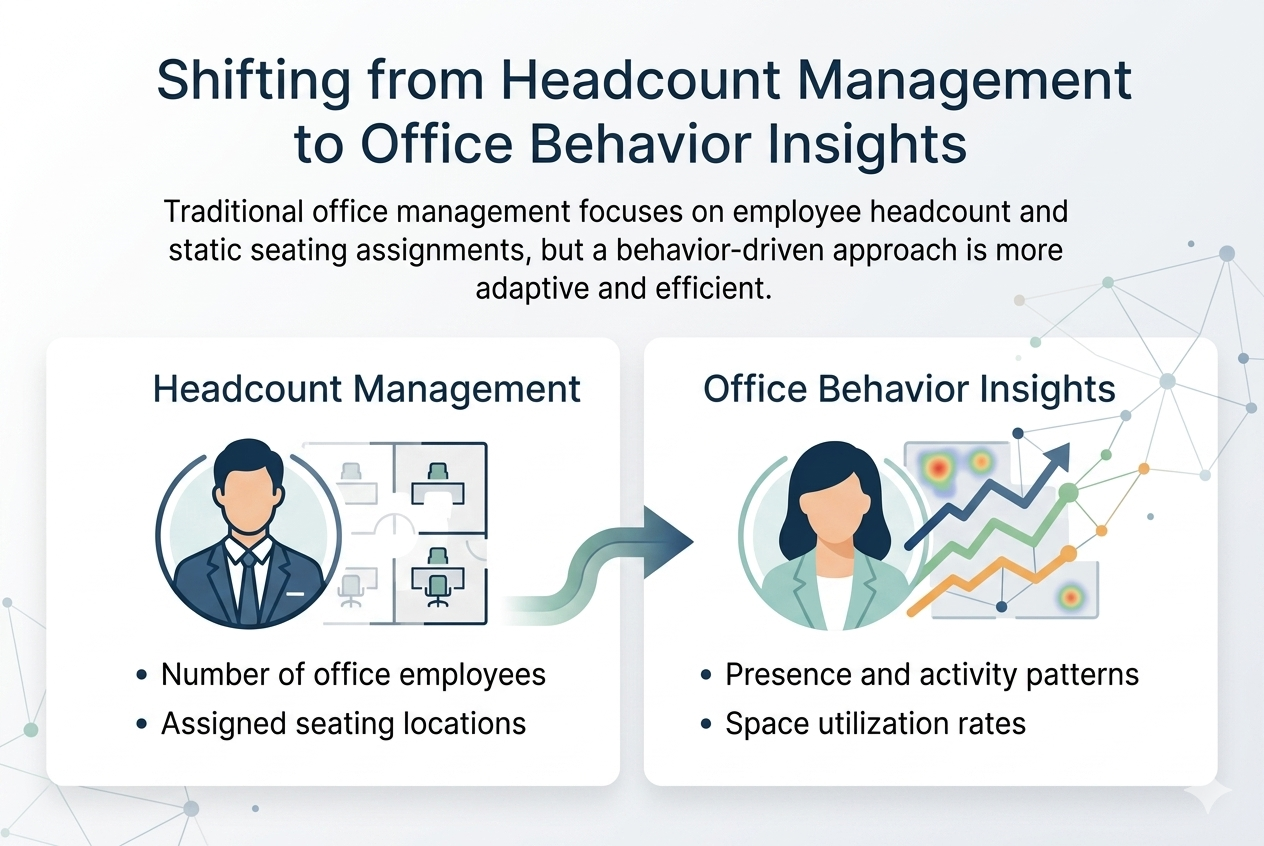
For many years, office management has been guided by a simple and static principle: headcount. Organizations planned their offices by counting how many employees they had, assigning each person a desk, and arranging seating based on organizational charts. Space planning focused on where employees should sit rather than how they worked.
This model once made sense. Employees came to the office every day, teams worked side by side, and desks were occupied most of the time. But today’s workplace looks very different. Hybrid work, flexible schedules, frequent travel, and remote collaboration have fundamentally changed employee behavior. Yet many offices are still managed using assumptions from a past era.
As a result, there is a widening gap between how offices are designed and how they are truly used. Desks sit empty for days at a time, entire zones remain underutilized, and energy is consumed to power spaces that no one occupies. At the same time, certain areas feel overcrowded on peak days, creating frustration and inefficiency. This is not a people problem—it is a management model problem.
To address this, organizations must shift office management away from headcount and toward office behavior patterns and insights.
The Hidden Cost of Headcount-Based Office Planning
Headcount-based office management treats office usage as a constant. It assumes that if there are 1,000 employees, close to 1,000 desks are needed, and that those desks should be permanently assigned. In reality, employee presence fluctuates daily and weekly. People take vacations, travel for business, work from home, or spend days in meetings instead of at their desks.
Because these behaviors are not measured or considered, decision-makers lack visibility into real usage patterns. Offices are planned for maximum theoretical capacity rather than average or realistic demand. This leads to wasted space, unnecessary operational costs, and missed opportunities to improve employee experience.
Energy consumption is one of the clearest examples. Lighting, heating, cooling, and cleaning are often applied uniformly across the office, regardless of actual occupancy. Vacant desks still consume energy, and unused floors are maintained as if they were fully active. Over time, these inefficiencies translate into significant financial and environmental costs. By estimation, more than 30% operation cost are wasted in traditional office mode.
A New Perspective: Managing Offices Based on Behavior
Office behavior insights start with a shift in mindset. Rather than asking how many people the organization employs, leaders begin to ask how people actually use the office. This includes understanding when employees come in, where they spend their time, how long they stay, and which facilities they rely on most.
This approach shows that not every employee needs a permanent desk and that the office should be flexible enough to support different work patterns. It also acknowledges that offices are dynamic environments, with demand changing by day, team, and activity.
Rethinking Who Needs a Dedicated Desk
One of the most impactful insights organizations can gain is understanding how many people truly need an assigned desk. In most modern workplaces, only a portion of employees require daily access to a specific workstation. These may include roles that depend on specialized equipment, secure data access, or consistent on-site presence.
For many others, desk usage is intermittent. Some employees come to the office two or three days a week. Others visit primarily for meetings or collaboration sessions. When desk usage is measured over time, organizations often discover that the actual demand for permanent seating is far lower than total headcount.
By aligning desk assignments with real behavior rather than job titles alone, organizations can significantly reduce the number of fixed desks without negatively impacting productivity. This creates flexibility, lowers real estate costs, and opens space for more collaborative or purpose-driven environments.
Designing Hybrid Workstations Around Team Behavior
Once the need for permanent desks is clarified, the next step is determining who should use hybrid or shared workstations. Hybrid desks are most effective when they are designed around predictable behavior, not random availability.
Employees who work in similar functions, departments, or project teams often share attendance patterns. Behavioral insights can reveal when overlap is high and when capacity is available. This makes it possible to create shared desk pools that feel reliable rather than chaotic.
Importantly, hybrid workstations should not feel like a downgrade. When planned correctly, they support flexibility while maintaining proximity to teammates, relevant resources, and collaboration areas. This is especially valuable for departments that coordinate work in cycles or sprints, where in-person collaboration matters but daily presence does not.
Measuring Real Office and Facility Utilization
Assigning hybrid desks is only the beginning. The true value of behavior-based office management comes from continuously measuring how the office is used.
At an individual level, this includes understanding how often employees come in, how long they stay, and which types of spaces they use most. At the broader office level, utilization data reveals which floors, zones, or facilities experience high demand and which remain underused.
These insights help organizations identify imbalances. Some areas may consistently feel crowded, while others are rarely occupied. Instead of relying on anecdotal feedback or occasional surveys, leaders can make decisions backed by evidence. Underused areas can be redesigned, repurposed, or consolidated, while high-demand zones can be enhanced without expanding the building footprint.
Defining a Healthy Utilization Target
A common misconception is that higher utilization is always better. In practice, an office that is constantly full is neither comfortable nor productive. Crowded environments increase noise, reduce access to resources, and discourage employees from coming in.
Experience and industry benchmarks suggest that an office utilization rate of around 70 to 75 percent represents a healthy balance. At this level, space is used efficiently without feeling cramped, and there is enough flexibility to absorb peak days or special events.
Utilization should always be evaluated alongside density metrics, such as people per square foot or square meter, and against relevant industry standards. The goal is not maximum occupancy, but sustainable, comfortable, and adaptable usage.
Improving the Effectiveness of Meeting and Event Spaces
Desks are only part of the office equation. Meeting rooms, conference areas, and event spaces are critical to collaboration, yet they are often poorly measured. Booking systems alone do not reveal whether rooms are actually used as intended.
Behavior-based insights help organizations understand how often meetings occur, how long they last, and how buffer times affect availability. In many offices, large conference rooms are booked for small meetings, while smaller rooms are in constant demand. Some rooms remain reserved on calendars but are never occupied.
By measuring real usage rather than bookings alone, organizations can redesign their meeting spaces to better match demand. This may involve resizing rooms, adjusting buffer policies, or converting underused event areas into flexible collaboration zones.
Visualizing Usage Through Office Heatmaps
One of the most effective ways to communicate behavioral insights is through visual tools such as office utilization heatmaps. These diagrams show how different areas of the office perform over time, making patterns immediately visible.
High-usage zones stand out clearly, while underutilized spaces become obvious candidates for change. When leaders can see how the office breathes throughout the day and week, decision-making becomes faster, more confident, and more aligned with reality.
Transform into a Usage-Based Office Model
The future of office management is not about choosing between remote and in-office work. It is about designing offices that respond intelligently to how people actually work.
A usage-based office encourages quiet focus during low-activity periods and supports productive collaboration when teams come together. Services such as energy, cleaning, and security can be scaled based on real demand rather than fixed schedules. Space becomes an asset that adapts, not a cost that remains static.
Conclusion
Headcount-based office management belongs to a different era. In today’s hybrid workplace, it creates waste, hides inefficiencies, and limits flexibility.
By shifting to office behavior insights, organizations can align space with real demand, reduce unnecessary costs, and design environments that support both focused work and meaningful collaboration. The future office is not defined by how many people an organization employs, but by how intelligently it uses space to support human behavior.